The world has changed, the way you run your company didn't.
We work inside your week, rebuild how your business operates, and leave it running without us.
The AI is the easy part.
It's the same technology everyone else has.
- 10 %AI models
- 20 %Tech and data
- 70 %People and process
The hard part is your processes and your people's habits.
That's work, not something you buy.
The brain is yours. The tools you can buy.
Here's the work.
Workflow
How work moves gets designed, not inherited.
The path from first contact to finished job gets rebuilt around what's possible now. Steps that only exist because the old tools were weak come out, and what's left is shorter and harder to break.
Routine
The repetitive work stops needing a person on it.
Checking, chasing, copying between systems, assembling the same report every Monday. It's the difference between a week spent running the company and a week spent keeping up with it.
Knowledge
What the company knows stops living in people's heads.
How you quote, what you promised which client, why the last project went the way it did. Organised, and in a form the AI can actually use, so it's still there when the person who knew it is on holiday or gone.
Judgement
How you decide is something the company can repeat.
The rules you apply, the calls you would make yourself, written down and open to inspection. It's the difference between a company that runs when you're in the room and one that runs when you aren't.
That's the company side. The bigger half is what it does to your people.
Skills aren't the problem.
Follow-through is.
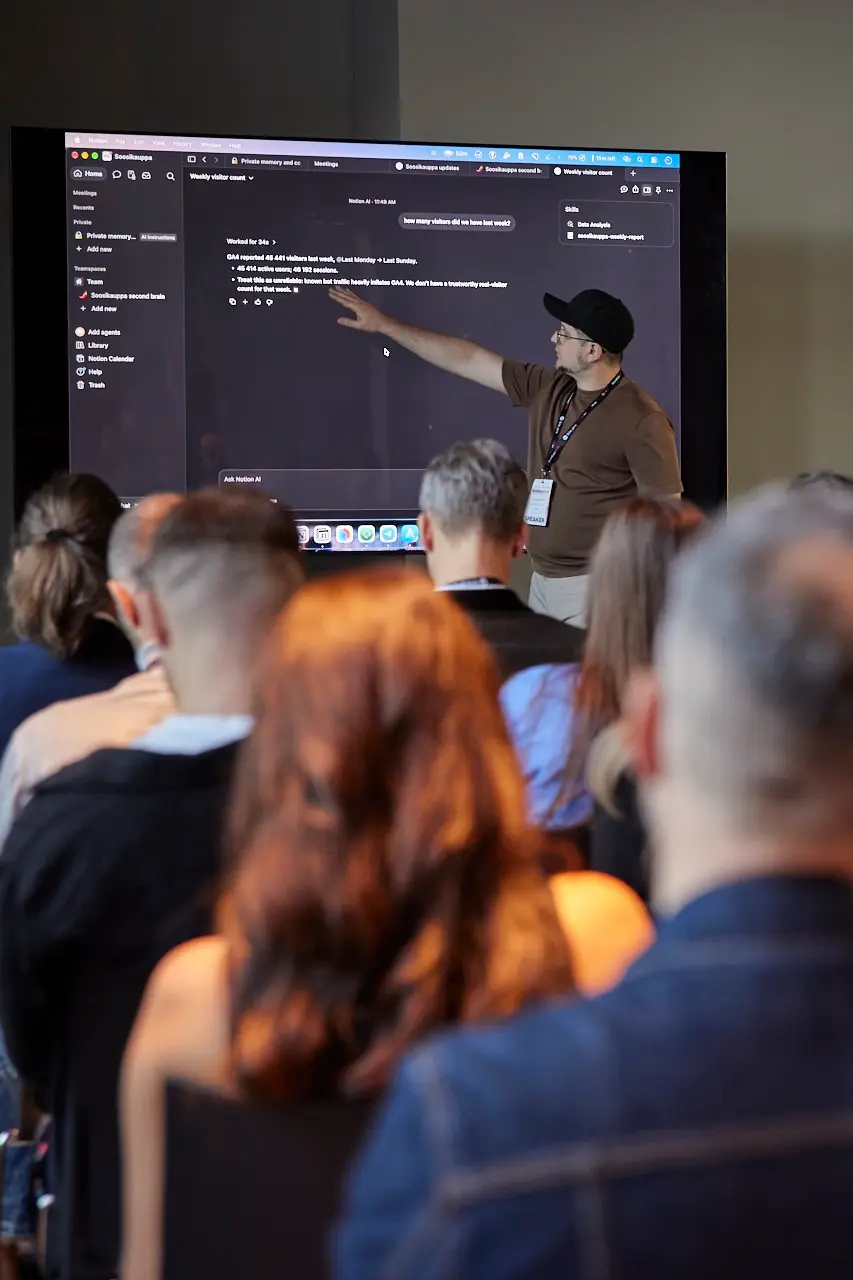
We sit with the sceptics too, like the accountant who doesn't trust AI. In her language, at her pace. The goal is better work, not fewer people.
If the new way takes more effort, people go back to the old one. So we choose tools anyone can learn in an afternoon, and make the right way the easiest one.
We grow an AI integrator inside your team: a person who knows your business and learns the tools. When we leave, they keep it running.





Three domains.
No handover in the middle.
Business
The P&L before the roadmap.
We have run companies and carried their P&L ourselves: sales, projects, product, board seats. We read your numbers the way an owner does, not the way a vendor does.
OperationsPricingUnit economicsBusiness modelsReportingE-commerce
Tech & AI
Built, not just recommended.
We build and run what we propose: infrastructure, data, integrations and AI agents in daily production. Nothing gets promised that can't be built.
AgentsWeb developmentDatabasesData pipelinesIntegrationsInternal tools
People & change
From rollout to routine.
Tools only pay off once people use them. We run the training, sit with the sceptics and measure what actually gets used, until the new way is simply how work gets done.
TrainingWorkshopsAdoptionChange managementOnboarding
How an engagement runs.
Audit

Interviews with leadership and with the people who actually do the work: how work really flows, where it gets stuck, and the tools it all runs on. It ends with a prioritised plan, delivered in a workshop with your team.
Sprints
We set up your second brain and company OS, with concrete outputs every cycle, like software development. By the end your team has the knowledge to keep going without us.
Advisory
Your team runs it, with your AI integrator in charge. We stay on as advisors for as long as you want us.
What we do. What we don't.
- Running your marketing: SEO, ads and content as a service
- Your product's engineering and codebase
- Product roadmap decisions
- Hiring or HR decisions
- Corporate strategy beyond 18 months
- Anything leadership has not explicitly asked for
- You are pre-revenue
- You want a tool bolted on, not the company changed
- You need someone to execute a plan that is already decided
- Leadership is not in the room
- Nobody on your side will own it after us
From 15 000 € a month.
- Audit included
- One team instead of a stack of vendors
- Advisory continues afterwards, if you want it
We sit where decisions get made and push the rollout forward.
When someone is stuck, we answer that week, not three weeks later.
Weekly check-ins, anonymous team surveys, audits of what actually got used.
Notes from
the work.
Why companies fail at adopting AI, and how to make sure yours doesn't
The materials from my EcomExpo 2026 talk and workshop in Vilnius: the slides and the Notion template.
The AI tool I use every day costs cents and lives in the terminal
AIChat turns plain English into shell commands you approve before they run. The setup, the three modes I use daily, and why the whole thing costs cents.
I have quit Notion three times. Now I am setting a company up on it.
I keep abandoning knowledge management tools the moment they are finished. What changed my mind about the one everybody already knows, and what it costs.